<?xml version="1.0" encoding="utf-8"?><feed xmlns="http://www.w3.org/2005/Atom" ><generator uri="https://jekyllrb.com/" version="3.10.0">Jekyll</generator><link href="https://lc-linkous.github.io/feed.xml" rel="self" type="application/atom+xml" /><link href="https://lc-linkous.github.io/" rel="alternate" type="text/html" /><updated>2026-06-11T23:58:38+00:00</updated><id>https://lc-linkous.github.io/feed.xml</id><title type="html">lc-linkous.github.io</title><subtitle>not-a-blog with tutorials/examples for projects shared on GitHub that have additional hardware or physical components. Academic research and project highlights included</subtitle><entry><title type="html">Fall 2025! Major Project Updates</title><link href="https://lc-linkous.github.io/announcements/2025/08/24/general.html" rel="alternate" type="text/html" title="Fall 2025! Major Project Updates" /><published>2025-08-24T00:00:00+00:00</published><updated>2025-08-24T00:00:00+00:00</updated><id>https://lc-linkous.github.io/announcements/2025/08/24/general</id><content type="html" xml:base="https://lc-linkous.github.io/announcements/2025/08/24/general.html"><![CDATA[<style>
.justified-content {
    text-align: justify;
    text-justify: inter-word;
}
</style>

<div class="justified-content">
<p> 
Happy Fall 2025! 
</p>
<p> 
This is a general update that will appear at the top of my <a href="https://lc-linkous.github.io/posts">post list</a> (for the time being) as I release a set of previously archived posts that have been on hold until related publications appeared online. There are about a dozen posts and a few tutorial pages that will begin showing up over the next few days. Amongst these are the AntennaCAT introduction, some explanation of the optimizer library, and an introduction of educational materials. There are also a few posts on my 'bookshelf' reading list where I'm documenting a selection of my hard-copy references for course and tutorial development.  
While the move to a GitHub page has been an interesting reformat, it has also given me the chance to update and document a lot of pre-existing projects. Some of the material appearing here might be an updated repost if it looks familiar, but most of it is new. I'm also doing a major pivot from previous formats and linking associated GitHub repositories with testable material.
</p> 
<p> 
The center of this 2025 update is my <a href="https://github.com/LC-Linkous/AntennaCalculationAutotuningTool">AntennaCAT software suite</a>, which was my <a href="https://scholarscompass.vcu.edu/etd/7841/">2024 Ph. D dissertation</a>. It has also been in a <a href="https://ieeexplore.ieee.org/document/11063361">recent magazine publication</a>, and has seen the first major 2025 release... and the first minor release to clear up some Windows 11 bugs.  The optimizers included in AntennaCAT have also been updated for individualized unit testing of mathematically defined problems. Explanations of the methodology, usage, and resources for this project are all making their way to the <a href="https://github.com/LC-Linkous/AntennaCalculationAutotuningTool/wiki">wiki pages</a> and this GitHub page. The Objective Function Test Suite, which is our name for the collection of mathematical functions that can be used directly with any of the AntennaCAT optimizers, provides (standardized) benchmarking capabilities for optimizer evaluation. The cat-shaped Wi-Fi band (2.4 GHz, 5 GHz, 5.8 GHz, 6 GHz) antennas are also public, and the .DXF for some of the designs are available. The rest will show up eventually, including explanations of how they work and the design process for tuning them.
<p>
Alongside AntennaCAT, I'm publishing a collection of specialized/focused tools that have emerged from various research projects and experimental work. This includes (in-development) Python libraries and examples for the <a href="https://github.com/LC-Linkous/tinySA_python">tinySA</a> and <a href="https://github.com/LC-Linkous/nanoVNA_python">NanoVNA devices</a>. The goal of this is to offer programmatic control for RF testing enthusiasts and professionals, but also make the material accessible for beginners.
</p> 
<p> 
The newest material I've publicized (at least on GitHub) includes several educational samples for <a href="https://github.com/LC-Linkous/cryptography_examples">cryptography</a>, <a href="https://github.com/LC-Linkous/2024-URSI-NRSM-1265">machine learning for antennas</a>, <a href="https://github.com/LC-Linkous/reverse_engineering_notes">reverse engineering</a>, and some <a href="https://github.com/LC-Linkous/computer_vision_notes">computer vision</a> work. These are the public parts of a series of courses I have been developing for undergraduate level research over the last few years. Tutorials and material samples will become public over the next few months.
</p> 
<p>
Note: This post was private until publication (July 2025), and then released publicly Aug. 2025
</p>
</p></div>]]></content><author><name></name></author><category term="announcements" /><category term="general" /><summary type="html"><![CDATA[]]></summary></entry><entry><title type="html">Cat Antennas</title><link href="https://lc-linkous.github.io/antennas/2025/08/10/antennadesign.html" rel="alternate" type="text/html" title="Cat Antennas" /><published>2025-08-10T00:00:00+00:00</published><updated>2025-08-10T00:00:00+00:00</updated><id>https://lc-linkous.github.io/antennas/2025/08/10/antennadesign</id><content type="html" xml:base="https://lc-linkous.github.io/antennas/2025/08/10/antennadesign.html"><![CDATA[<style>
.justified-content {
    text-align: justify;
    text-justify: inter-word;
}
</style>

<div class="justified-content">


<p> 
This material was first featured in the 'Cat Antennas' section of my <a href="https://github.com/LC-Linkous/research_antenna_collection?tab=readme-ov-file#cat-antennas"> research antenna collection GitHub repository</a>.
</p>

<figure>
<img src="/media/imgs/antennacat/CatAntenna_2.png" alt="Experimental samples of WiFi antennas with copper conductors shaped like cats." style="width:500px" />
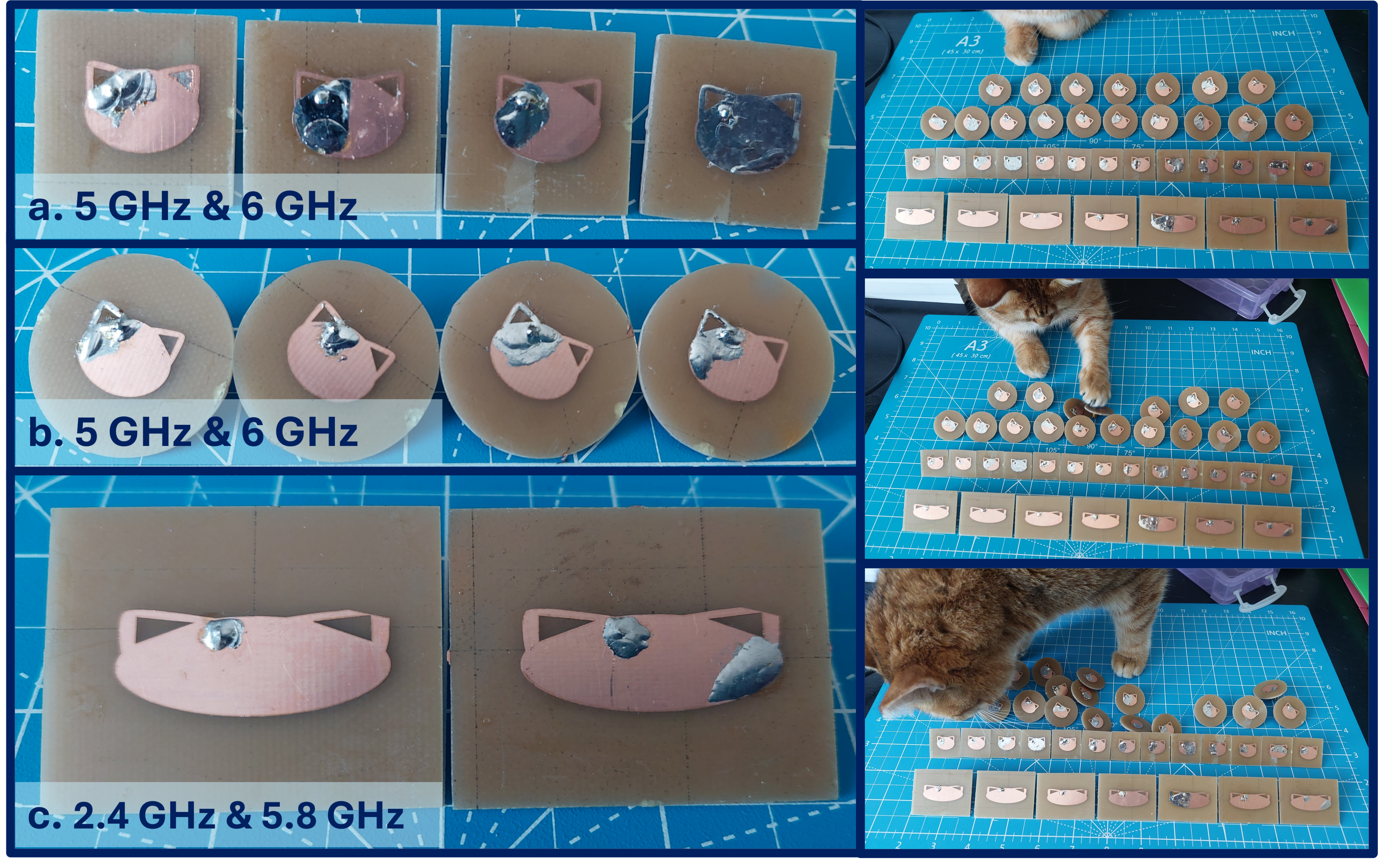
<figcaption>Fig.1 - Experimental samples of WiFi antennas with copper conductors shaped like cats. On the left side are three combinations of the dual-band design labeled with their frequencies. On the right side, Sybil (the inspiration for the design) delicately knocks over carefully placed samples. </figcaption>
</figure> 

<br />

<p>
The Cat Antenna Collection is a group of design where the conductor on the planar patch looks like the outline of a cat's face, complete with ears. These antennas are modified oval patches on double-sided copper FR4 with permittivity of ~4.4. They are designed to operate at two independent and tunable frequencies.
</p>


<p>
The design features a probe-fed configuration with a full copper ground plane and a decorative conductor. The conductor is a modified oval patch design where triangular 'ears' have been added to resemble a cat. This design has been simulated and then verified experimentally with multiple frequency pairs, but targeted Wi-Fi frequencies (i.e., 2.4 GHz, 5 GHz, 5.8 GHz, 6 GHz) were the preferred test designs so that we could use them for wireless transmission demos. Each antenna has two frequencies that can be tuned independently via different dimensional aspects - one frequency is controlled by the cheek-to-cheek distance,  while the second frequency is determined by the head-to-chin distance. Simulation results show little preference for which orientation produces the lower frequency. 
</p>
<p>
The design demonstrates good tolerance to manufacturing variations; even to the point where decorative 'calico spots' created with solder during assembly do not impact performance in a noticeable or replicable way. The design is sensitive to the probe location, which is placed towards the left ear. In both simulation and experiments, any deviation from this location (on the front) causes changes in the return loss (S11) balance. To prevent an electrical short, a 1/4 in drill bit was used to remove a circle of copper from the ground plane around the probe location. A drill was used to ensure a consistent size of removal, and we were careful to not drill beyond the surface copper and into the FR4. This antenna design was NOT sensitive to this copper removal process placement, as long as it was close to being centered on the probe feed location. The size of the drill bit was chosen so that the removed copper radius was roughly that of the Teflon on the SMA connector used for the probe feed. The dual frequencies achieve better balance (i.e., that the dual band frequencies are roughly the same with regards to S11 and gain) when implemented on a round ground plane rather than rectangular, which was not completely unexpected as the rectangular design would have several places where the conductor is close enough to the edge of the board for there to be potential issues with the 'edge effect'. Both hand-cut and milled board outlines produced similar measured results, so this is an issue with the shape of the ground plane.
</p>
<p>
AntennaCAT was used to test Particle Swarm Optimization (PSO) variations on the cat antennas described here. The oval-based antennas, unlike the AntennaCAT logo antennas, are tunable by hand and mathematically describable without simulation. PSO has been used on many, if not all, of the designs in the Research Antenna Collection for either experimental purposes or out of curiosity for performance. PSO was able to place the probe for a balanced S11 and Gain between the two frequencies of the oval design, but the difference in the placement was only significant in simulation. That is, the placement found by PSO was optimal by nanometers, and any deviation from that exact placement (which was too specific for hand assembly) preformed the same as the original placement. It turns out that probe location is extremely sensitive, and the changes due to being slightly out of place with the feed are not significant. 
</p>

<p>
A build of materials, measurement results, and .DXF files for some of the cat antennas are available at <a href="https://github.com/LC-Linkous/research_antenna_collection?tab=readme-ov-file#cat-antennas"> https://github.com/LC-Linkous/research_antenna_collection</a> 
</p>

</div>]]></content><author><name></name></author><category term="antennas" /><category term="antennacat" /><category term="antennas" /><category term="examples" /><summary type="html"><![CDATA[]]></summary></entry><entry><title type="html">What is an AntennaCAT?</title><link href="https://lc-linkous.github.io/antennacat/2025/08/02/antennacat.html" rel="alternate" type="text/html" title="What is an AntennaCAT?" /><published>2025-08-02T00:00:00+00:00</published><updated>2025-08-02T00:00:00+00:00</updated><id>https://lc-linkous.github.io/antennacat/2025/08/02/antennacat</id><content type="html" xml:base="https://lc-linkous.github.io/antennacat/2025/08/02/antennacat.html"><![CDATA[<style>
.justified-content {
    text-align: justify;
    text-justify: inter-word;
}
</style>

<div class="justified-content">

<img src="/media/imgs/antennacat/transparent-antennaCAT-logo.png" alt="AntennaCAT logo" height="200" />

<p> 
AntennaCAT started as a 2023 conference project meant to automate the CAD modeling process for several common topologies. It then quickly expanded in to a closed-loop automation system that would control EM simulation software from the outside using a custom API. From there, features including optimization and machine learning for hyper parameter tuning were added to address research needs. The AntennaCAT software has now been released open-source, free to use, and as a continuing project. This software suite was designed to lower the barrier to entry into a traditionally difficult field. And to support that, I am using these blog-style posts to explain the mechanics and inner workings of our work on this software in a less formal technical lens than my  <a href="https://scholarscompass.vcu.edu/etd/7841/">2024 dissertation</a> or the <a href="https://github.com/LC-Linkous/AntennaCalculationAutotuningTool/wiki">official AntennaCAT wiki</a>.
</p>

<p> 
The initial concept for what would be AntennaCAT started with Ansys HFSS and simulating rectangular patch antennas. Ansys HFSS is an electromagnetic (EM) simulation software used to calculate how an antenna (or radio-frequency-based technology) will operate in the real world. These simulations are based on computer assisted design (CAD) modeling where all materials in a design are mirrored digitally, even down to how individual materials respond to electrical signals (or waves). When a design is modeled as true-to-life as possible, the simulation results will be highly accurate due to the fact that it is possible to calculate an electrical (or magnetic, etc.) wave propagates in different materials, such as air.  
</p>

<p>
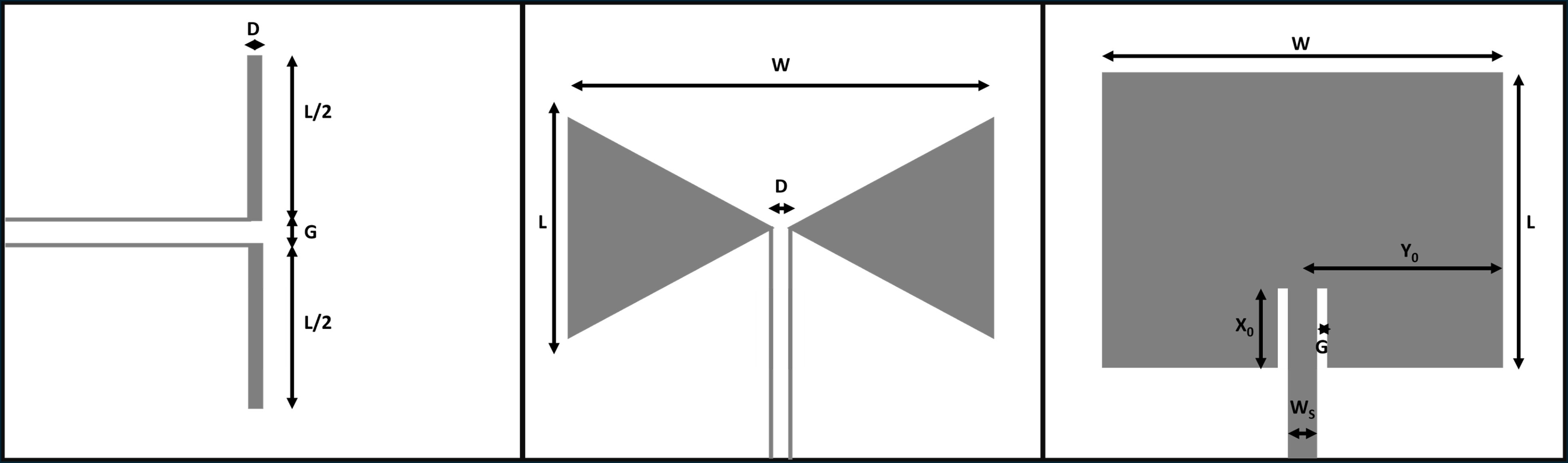
When an antenna design can be fully calculated, it is called an 'analytical' design. Common examples of fully analytical (or mathematically defined) designs are shown below in Fig 1. AntennaCAT includes a built-in calculator for the two designs on the left and right sizes, and the middle bowtie design is included in a replication study. All three designs have physical parameters (such as the length of their sides, or the gaps between elements) that can be calculated based on a target frequency. Simulation is typically used to check for any variations that happen between the mathematical calculations and the built design that might be caused by differences in material quality, manufacturer tolerances, or unique environmental needs. 
</p>

<figure>
<img src="/media/imgs/antenna_design/antenna_examples_simple1.png" alt="Three stylized antenna shapes with labels for variables." style="width:500px" />
<figcaption>Fig.1 - Simplified antenna topologies with labels for changeable physical variables. From left to right: half-wave dipole, planar bowtie, and strip-fed rectangular patch antennas </figcaption>
</figure> 

<br />

<p>
Knowing that this relation between design, calculation, simulation, and real world results existed, we began looking at how to automate the 'tuning' process needed to bring the simulation inline with the desired design. For instance, the rectangular patch antenna equations consider the length and width of the rectangle, the depth of the substrate (the material between the ground plane and the front conductor), and the electrical properties. But while there are several common preferences for deciding the length and width of the gap (the notches on either side of the strip feed in Fig. 1), there really isn't any set equation for that feature (even including the preferences for L/4 as a starting point for the cut). Which makes simulation a highly appealing method for iterating through designs to find a candidate for a real-world experiment.
</p>

<p>
However, as the number of changeable features in the antenna design grows, so does the number of iterations that are likely needed to find a solution. Which highlights the need for automating the design process. EM simulation software suites such as Ansys often have some type of parameter sweep functionality pre-built in, but it will vary based on the software how much control a user has over the search process, stop conditions, and the data logging. AntennaCAT was created to address this gap, with the additional benefit of being able to create custom optimizers or implement those in popular literature (we created 12 base optimizers to start with). Now that AntennaCAT has been released as open-source (officially), we are working to implement some features suggested by initial student volunteer testers, and to reintegrate the hooks for other EM simulation software beyond the unit testing. Other optimizers, replication studies, and project features are also being implemented as the software develops. 
</p>

</div>]]></content><author><name></name></author><category term="antennacat" /><category term="antennacat" /><category term="open_source" /><summary type="html"><![CDATA[]]></summary></entry><entry><title type="html">Introducing AntennaCAT</title><link href="https://lc-linkous.github.io/antennacat/2025/08/01/antennacat.html" rel="alternate" type="text/html" title="Introducing AntennaCAT" /><published>2025-08-01T00:00:00+00:00</published><updated>2025-08-01T00:00:00+00:00</updated><id>https://lc-linkous.github.io/antennacat/2025/08/01/antennacat</id><content type="html" xml:base="https://lc-linkous.github.io/antennacat/2025/08/01/antennacat.html"><![CDATA[<style>
.justified-content {
    text-align: justify;
    text-justify: inter-word;
}
</style>

<div class="justified-content">

<p>
AntennaCAT is now live!
</p>
<p>
After several conference publications and (finally!!) a completed dissertation, the open-source AntennaCAT software is now live and free to use on GitHub at <a href="https://github.com/LC-Linkous/AntennaCalculationAutotuningTool">https://github.com/LC-Linkous/AntennaCalculationAutotuningTool</a>. 
</p>

<p> 
The Antenna Calculation and Autotuning Tool (AntennaCAT) software suite is a comprehensive implementation of machine learning to automate, evaluate, and optimize the antenna design process using EM simulation software. It utilizes a combined antenna designer pre-loaded with replication studies and internal calculator to accelerate the CAD construction and EM simulation of several common topologies, while eliminating model disparity for automated data collection. In particular, this work includes the capability to create and export structured datasets from the aforementioned EM software for iterative improvement and includes an expandable selection of optimizers. AntennaCAT is designed with three things in mind: accessibility, adaptability, and experimentation. 
</p>
<p>
The AntennaCAT software suite and related examples have appeared in the following publications:
    <ol>
    <li>L. Linkous, E. Karincic, J. Lundquist and E. Topsakal, "Automated Antenna Calculation, Design and Tuning Tool for HFSS," _2023 United States National Committee of URSI National Radio Science Meeting (USNC-URSI NRSM)_, Boulder, CO, USA, 2023, pp. 229-230, doi: 10.23919/USNC-URSINRSM57470.2023.10043119. </li>
    <li>E. Karincic, L. Linkous, and E. Topsakal , "Generalized Machine-Learning Particle Swarm Optimization Antennas for CBRS," 2023 United States National Committee of URSI National Radio Science Meeting (USNC-URSI NRSM), Boulder, CO, USA, 2023 https://www.usnc-ursi-archive.org/nrsm/2023/papers/1065.pdf (supporting material demonstrating the early genetic algorithm) </li>
    <li>L. Linkous, J. Lundquist and E. Topsakal, "AntennaCAT: Automated Antenna Design and Tuning Tool," _2023 IEEE USNC-URSI Radio Science Meeting (Joint with AP-S Symposium)_, Portland, OR, USA, 2023, pp. 89-90, doi: 10.23919/USNC-URSI54200.2023.10289238. </li>
    <li>L. Linkous, J. Lundquist, M. Suche, and E. Topsakal, "Machine Learning Assisted Hyperparameter Tuning for Optimization," _2024 IEEE International Symposium on Antennas and Propagation and ITNC-USNC-URSI Radio Science Meeting_, Florence, Italy, 2024 </li>
    <li>L. Linkous and E. Topsakal, "Machine Learning Assisted Optimization Methods for Automated Antenna Design," _2024 United States National Committee of URSI National Radio Science Meeting (USNC-URSI NRSM)_, Boulder, CO, USA, 2024, pp. 377-378, doi: 10.23919/USNC-URSINRSM60317.2024.10464597. </li>
    <li>L. Linkous, “Machine Learning Assisted Optimization for Calculation and Automated Tuning of Antennas,” VCU Scholars Compass, 2024. https://scholarscompass.vcu.edu/etd/7841/</li>
    <li>L. Linkous, J. Lundquist, M. J. Suche and E. Topsakal, "AntennaCAT: Automated antenna design with machine learning-assisted optimization [Open Source]," in _IEEE Antennas and Propagation Magazine_, vol. 67, no. 3, pp. 87-96, June 2025, doi: 10.1109/MAP.2025.3560851 </li>
    </ol>

</p>

<p> 
In addition to the main repository, a <a href="https://github.com/LC-Linkous/AntennaCalculationAutotuningTool/wiki">AntennaCAT wiki on GitHub</a> has been created with full documentation of all steps from how to access and download the AntennaCAT code, to how to run it, to how to customize designs. These wiki pages include a mix of overview and tutorials to cover the range of features. As this is a dynamic and developing project (as is most early open-source projects), the wiki will have the most up to date descriptions of AntennaCAT and it's features. 
</p> 
<p> 
Posts, such as this one, will go into detail of specific, core AntennaCAT features and the reasoning behind some of the design choices. The posts are much less formal than the released publications, less technically detailed than many of the wiki articles, and are meant to offer insight into how the logic of the software and integration works. Posts and tutorials related to AntennaCAT will typically be published with the <a href=" https://lc-linkous.github.io/tags/antennacat/">antennacat tag</a>.

</p> 

<p>
Note: This post was private until magazine publication (July 2025), and then released publicly Aug. 2025
</p>
</div>]]></content><author><name></name></author><category term="antennacat" /><category term="antennacat" /><category term="open_source" /><category term="research" /><category term="software" /><summary type="html"><![CDATA[]]></summary></entry></feed>